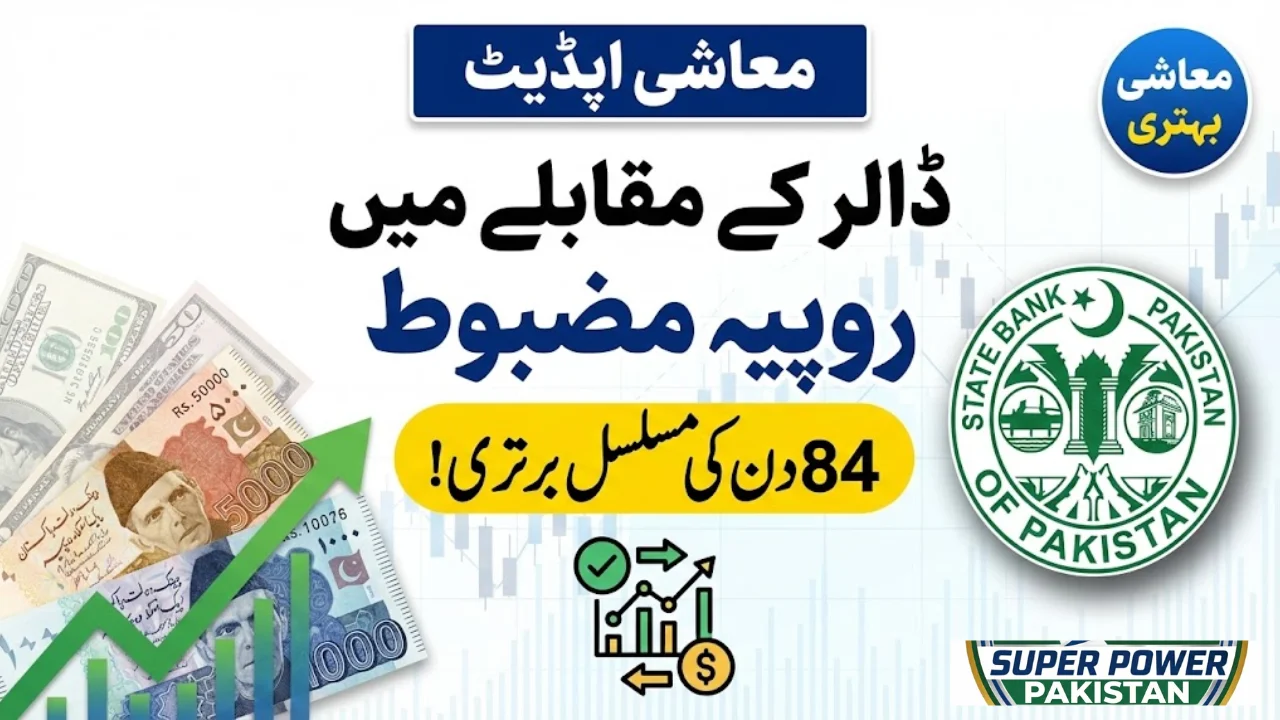
For currency watchers and businesses across Pakistan, the foreign exchange market delivered another calm session. The Pakistani Rupee (PKR) strengthened against the US Dollar for the 84th consecutive trading day, extending a rare streak of stability that has held the interbank market steady for nearly three months.
Although the daily movement was small, the continuation of this trend carries significant economic and psychological importance at a time when currency volatility has historically hurt prices and planning.
What Happened in Today’s Interbank Session
In Wednesday’s interbank trade, the rupee closed slightly stronger against the US Dollar, adding another green session to its ongoing run.
Key USD Closing Detail
-
Closing rate: PKR 279.90 per US Dollar
-
Daily movement: Gain of 1 paisa
-
Streak: 84 consecutive days without depreciation
This marks one of the longest uninterrupted periods of rupee stability in recent years.
How PKR Performed Against Other Major Currencies
The rupee’s performance was not limited to the US Dollar. It showed mixed but mostly stable movement against other global currencies.
Notable Currency Movements
-
UAE Dirham (AED): PKR closed slightly stronger
-
Saudi Riyal (SAR): PKR ended in green
-
British Pound (GBP): PKR gained Rs. 1.15
-
Australian Dollar (AUD): PKR weakened by 14 paisas
These movements reflect global currency fluctuations, not local instability.
Why the Rupee’s 84-Day Streak Matters
While a one-paisa gain may look insignificant, consistency is far more important than size in currency markets.
Key Reasons This Stability Is Important
-
Prevents sudden import-led inflation
-
Reduces panic dollar buying
-
Improves predictability for businesses
-
Supports government debt management
-
Stabilizes fuel and commodity pricing expectations
In Pakistan’s context, currency calm itself is a major achievement.
What Is Supporting the Rupee Right Now
The rupee’s continued stability is driven by control rather than artificial strength.
Key Supporting Factors
-
Strong monitoring of interbank and exchange companies
-
Crackdown on illegal dollar trade
-
Controlled demand for foreign currency
-
Better alignment between inflows and outflows
-
Reduced speculative pressure
Importantly, authorities are allowing market-based pricing, avoiding sharp forced appreciation.
Who Benefits From This Trend
Different sectors experience the impact in different ways.
Primary Beneficiaries
-
Importers of fuel, machinery, and raw materials
-
Businesses with dollar-linked costs
-
Consumers facing slower price increases
-
Government managing external payments
Exporters, however, may not see immediate gains, as a weaker rupee usually boosts export competitiveness.
Does This Mean Prices Will Fall
No — and this is important to understand.
Currency stability helps control future inflation, but it does not automatically reduce existing prices. Prices fall only when:
-
Supply improves
-
Taxes decrease
-
Energy costs drop
-
Structural reforms take effect
The current trend mainly prevents further shocks.
What to Expect in the Coming Days
Market analysts expect the rupee to remain range-bound, rather than showing sharp gains or losses.
Future movement will depend on:
-
Import demand, especially energy
-
External loan inflows and repayments
-
Global dollar strength
-
Domestic fiscal discipline
For now, the focus remains on maintaining stability, not chasing appreciation.
Common clarity for readers
Is the rupee rising strongly?
No. The gain is minimal, but the consistency is the real signal.
Can the rupee fall again suddenly?
Risk always exists, but controls have reduced sudden shocks.
Does this affect remittances?
It improves confidence but does not significantly change inflow volume.
Conclusion
The Pakistani Rupee’s 84-day winning streak against the US Dollar is not about dramatic gains — it is about discipline, control, and predictability. Closing near 279.90 with another green session reinforces confidence in the foreign exchange market.
While deeper economic challenges remain, sustained currency stability provides a necessary foundation for inflation control, business planning, and gradual economic recovery.